 Decks
DecksBrighton · Family Home · 2025
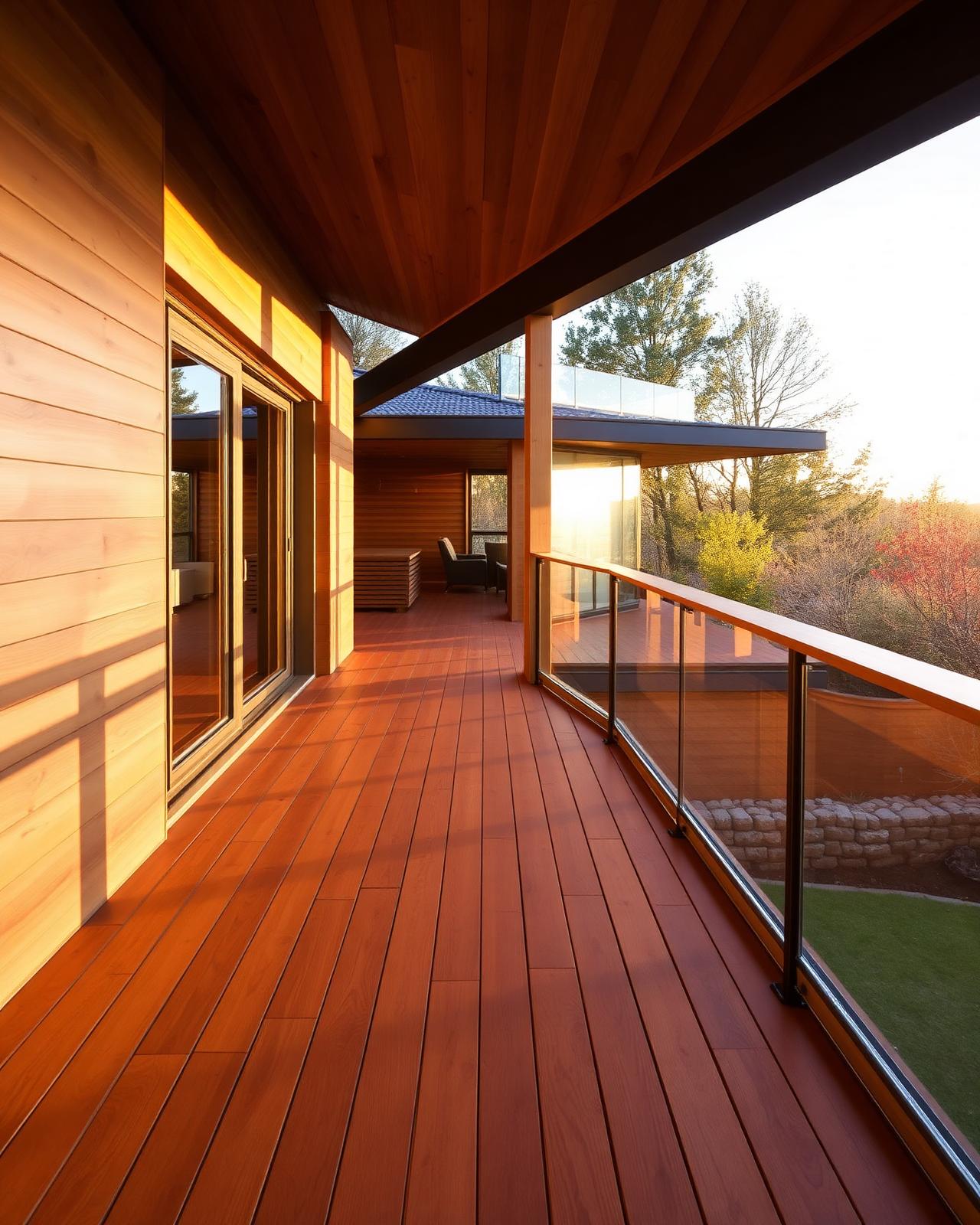
Bayside Merbau Deck Restoration
Ninety square metres of salt-damaged merbau stripped, brightened, sanded and re-oiled, with glass balustrade posts refinished in a matching tone.
- Natural Merbau Colourtone
Timber decks stripped, brightened and re-coated to a rich, even tone.
The short answer
Deck coating failure is nearly always a preparation failure. Old coating must be stripped, the timber neutralised and brightened to restore its pH, sanded where needed and moisture tested before thin, even coats of penetrating oil go on.
Decking failure is almost always a preparation failure. Old coating left in the grain, mill glaze on new boards or a deck stained while still damp will blotch within one summer.
We strip previous coatings, neutralise and brighten the timber to restore its pH, sand where the boards demand it, punch and fill proud nails, then apply penetrating oil in thin, even coats.
Typical specification: Cutek or Intergrain penetrating oils with UV inhibitors, tinted to enhance the natural species colour.
How we prepare
Preparation is where the money either goes or gets saved, and it is the part you cannot see once the job is finished. This is exactly what happens before colour goes on.
Residual film in the grain blocks penetration and causes blotching. Previous coatings are chemically stripped or sanded off rather than coated over.
Strippers leave timber alkaline and grey. A brightener returns the surface to a neutral pH and lifts the natural colour back, so the oil takes an even tone across every board.
Boards are sanded where splinters or raised grain demand it, proud nails punched below the surface, and loose screws and joist fixings checked while the deck is bare.
Timber above about 15% moisture will not accept oil evenly. We test rather than guess — a deck stained damp will blotch within one summer regardless of the product used.
Merbau and dense hardwoods
Cutek Extreme or similar penetrating oils that move into the timber rather than sitting on it, so there is no film to peel later.
Spotted gum and blackbutt
Intergrain UltraDeck or Nature's Timber Oil with UV inhibitors, tinted to enhance rather than mask the species colour.
Tannin management
Merbau bleeds tannin heavily on first wetting. We flush and manage it before coating so adjacent paving is not stained rust-brown.
Steps, posts and balustrades
Hand-finished with the same system, with extra attention to end grain where water enters first.
Hold us to these. They are written into every deck staining proposal we issue.
Every deck staining proposal we issue names the products, the number of coats and the preparation steps above, so you can compare it line by line against any other quote.
Request a written specificationCompare the options
Oils, stains and film coatings age very differently. This is what to expect on an exposed Melbourne deck.
| Finish | Appearance | Life before refresh | Failure mode |
|---|---|---|---|
| Penetrating oil | Rich, natural, low sheen | 12–18 months | Fades gradually, no peeling |
| Decking stain | Tinted, slightly more uniform | 18–24 months | Fades, can blotch on wear paths |
| Water-based film coat | Higher sheen, sealed look | 2–3 years | Peels at wear paths and end grain |
| Do nothing | Silver-grey weathering | n/a | Surface checking and splintering |
Covered and shaded decks hold a finish roughly twice as long as fully exposed ones.
Recent projects
Each case study documents the condition we started with, the preparation, the products, the colours and the finished result.
DecksBrighton · Family Home · 2025
Ninety square metres of salt-damaged merbau stripped, brightened, sanded and re-oiled, with glass balustrade posts refinished in a matching tone.
DecksDoncaster · Family Home · 2024
A 60sqm spotted gum deck under a hardwood pergola brought back in a single week, with post bases treated where ground moisture had begun to soften the timber.
Related articles
Our Knowledge Centre explains the decisions behind this work in full — costs, products, preparation and the mistakes that cause early failure.
Maintenance · 3 min read
Once a year, wash exterior walls with a soft brush and diluted detergent, treat any mould, clear gutters, inspect and re-caulk failed joints, and touch up exposed timber — a routine that typically adds three to five years to an exterior repaint cycle.
Read the guideCommon Paint Problems · 3 min read
Paint peels for four reasons: moisture behind the coating, inadequate surface preparation, incompatible coating layers, or applying paint over a chalky or dirty surface — and the repair differs completely depending on whether the paint peels between coats or back to the bare substrate.
Read the guideExterior Painting · 3 min read
In Melbourne, expect to repaint weatherboard every 8–12 years, rendered walls every 10–15 years, and window frames and doors every 5–8 years — north and west elevations typically need attention two to four years earlier than south and east ones.
Read the guideSurface Preparation · 3 min read
Use a sealer on new plaster and porous masonry, a stain-blocking primer on water marks and tannin-prone timber, an adhesion primer over glossy or previously oil-painted surfaces, and a tinted undercoat when making a dramatic colour change.
Read the guideQuestions
Real questions from Melbourne homeowners, answered the way we answer them at the kitchen table.
Question we have not covered? Send us photos with your enquiry and we will answer it against your actual surfaces, not a general case.
Ask us with photosWhere we work
Choose your suburb for local detail on housing stock, exposure and typical scope.
Also consider
Walls, ceilings, cornices and joinery finished to a furniture standard.
Weather-engineered systems for Melbourne's brutal seasonal swings.
Offices, retail, strata and hospitality painted around your trading hours.
Restoration-grade coatings that reset your roof's next twenty years.
Tell us about your painting project and a project manager will be in touch.